




- Achiever, when the Index score is 100
- Front Runner, when the Index score is between 65 and 99 (including both)
- Performer, when the Index score is between 50 and 64 (including both)
- Aspirant, when the Index score is less than 50.
OVERVIEW
UN General Assembly held on 25th September, 2015 adopted the
Agenda on “Transforming Our World: The 2030 Agenda for
Sustainable Development" which comprises of 17 Sustainable
Development Goals (SDGs) and 169 associated targets having
social, economic and environmental dimensions. The motto of the
2030 Agenda is to “Leave No one Behind” in the path leading to
sustainable development. The 2030 Agenda constitutes an ambitious
and long-term plan of action to end poverty, protect the planet,
and ensure that by 2030 all people enjoy peace and prosperity.
NITI Aayog is the nodal agency for implementation and
monitoring of SDGs in India. In order to achieve these Goals and
associated targets, Global Indicator Framework (GIF) has been
developed and is periodically revised. It can be restructured by
considering varied priorities and monitoring requirements of each
country/state. As part of this, Ministry of Statistics and
Programme Implementation (MoSPI) has developed National Indicator
Framework (NIF) and is revised periodically.
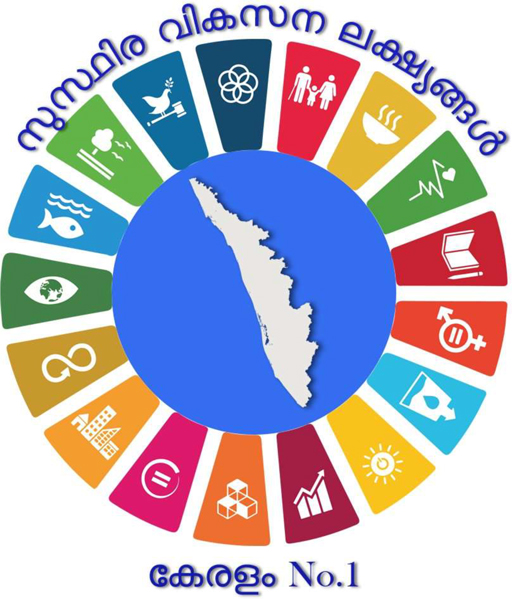
SDGs in Kerala
Kerala, situated on the south- western coast of India, stands as a beacon of exemplary development,
blending high human development indices with low poverty rates, even amidst moderate economic growth.
Often heralded as a benchmark for its progressive social policies, robust public health system, and outstanding
literacy rates, the state’s socio-economic achievements place it ahead of many Indian states and on par with more developed regions globally.
Economically, Kerala benefits from a diversified economy, with significant contributions from the tertiary sector,
particularly tourism, information technology, and services. Substantial remittances from its large expatriate community
have been instrumental in sustaining household incomes and fostering economic stability. In recent years,
the state has garnered international acclaim for its adept management of the COVID-19 pandemic, a testament to its well-established
healthcare infrastructure and efficient government response. Proactive and effective measures underscored its capacity to
protect public health and ensure community resilience.
The state’s unwavering commitment to sustainable development is reflected in its consistent top rankings across various national indices.
Leading in the SDG India Index, National Multidimensional Poverty Index, and State Health Index, it highlights success in advancing
human development and alleviating poverty. The state's performance in the SDG India Index 2023-24 is particularly noteworthy, as it retains
its top position in the overall ranking. Additionally, it holds the first position in SDG 2 (Zero Hunger), SDG 4 (Quality Education),
and SDG 7 (Affordable and Clean Energy),underscoring its leadership in sustainable development.
Despite these impressive achievements, the state recognizes the need for continuous improvements in infrastructure and environmental sectors
to fully meet the 2030 Agenda. Regular analysis and the implementation of a robust Institutional Framework are crucial for sustaining and advancing
its top position in sustainable development.
Kerala's remarkable journey serves as an inspiring model for other regions, showcasing that with commitment, innovation, and inclusive policies,
sustainable development is not just an aspiration but an achievable reality.
Kerala in SDG India Index
2023-24
Score : 79
Rank 1
Index 4.0


81


84

80

82

66

87


100

74

69

71

84

53

80

51

88

82

-
2020-21
Score : 75
Rank 1
Index 3.0
83
80
72
80
63
89
100
62
60
69
75
65
69
53
77
80
-
2019-20
Score : 70
Rank 1
Index 2.0
64
74
82
74
51
77
70
61
88
75
51
57
56
28
98
77
-
2018
Score : 69
Rank 1
Index 1.0
Achiever (100) Front Runner (65 - 99) Performer (50 - 64) Aspirant (0 - 49)
Improved Dropped No change